
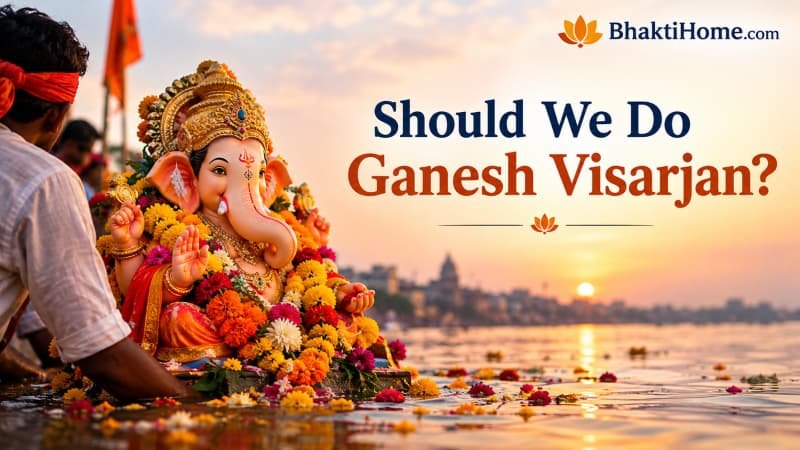
Should We Do Ganesh Visarjan? A Detailed Look at Belief, History, and Significance - Ganesh Visarjan is one of the most meaningful traditions associated with Ganesh Chaturthi, marking the ceremonial farewell of Lord Ganesha after the festival. For many devotees, the immersion of the Ganesh idol represents a beautiful reminder of the cycle of creation and dissolution, as well as the belief that Lord Ganesha returns to his divine abode after blessing his devotees. At the same time, questions about the environmental impact of idol immersion, particularly when idols are made from non-biodegradable materials, have encouraged many families and communities to reconsider how they observe the tradition. So, should we do Ganesh Visarjan? The answer can depend on personal beliefs, local customs, and how the ritual is carried out. Understanding the religious significance alongside modern environmental considerations can help families make an informed and respectful choice.
Introduction
Every year, as Ganesh Chaturthi draws to a close, millions of families across India and the diaspora carry an idol of Lord Ganesha to a river, lake, sea, or a bucket of water at home, and let it go. This act — Visarjan — is one of the most visible and emotionally charged Hindu rituals, drawing both deep devotion and, increasingly, sharp criticism on environmental grounds. This article looks at what the ritual means, where it came from, why it matters, why people continue to do it, why beliefs about it diverge so widely, and how to think about whether — and how — to do it today.
What Is Ganesh Visarjan
Visarjan literally means "immersion" or "letting go." At the end of the Ganesh Chaturthi festival, the clay idol of Ganesha that was ceremonially installed and worshipped for the duration of the festival is taken in procession — often with music, dance, and chanting — and immersed in a natural body of water: a river, lake, well, or the sea. Some households immerse on the very first day (Chaturthi), others on the third, fifth, or seventh day, but the most common and largest-scale immersions happen on the tenth day, Anant Chaturdashi, marked by huge public processions in cities like Mumbai and Pune.
As the idol enters the water, devotees chant "Ganpati Bappa Morya, Pudhchya Varshi Lavkar Ya" — "Hail Lord Ganesha, come again soon next year" — treating the moment not as an ending but as a promise of return.
The Belief Behind It
The ritual rests on a specific theological idea found in Agamic and Puranic worship traditions: the difference between the formless divine and a temporary form given to it for the purpose of worship.
- Avahan (invocation): At the start of the festival, a ceremony called pranapratishtha is performed, in which the deity's living presence is ritually invited into the clay image. Until this point, the idol is just a sculpted object; after it, devotees treat it as inhabited by the god.
- Visarjan (departure): Because the divine was never permanently bound to the clay — only invited to reside there for the festival's duration — the ritual concludes by respectfully releasing that form back into nature, freeing the deity from the temporary vessel.
Alongside this is a strong belief that Ganesha, as the remover of obstacles (Vighnaharta), takes with him the difficulties, sins, and negative energies of the household as he departs. His immersion is thus felt as a cleansing, not just a farewell.
A related textual story, often cited to explain the ten-day duration, tells of the sage Vyasa dictating the Mahabharata non-stop to Ganesha, who wrote it down for ten days without pause; at the end, his body had overheated from the intensity of the task, and he was cooled by being immersed in water.
Historical Origins
The worship of Ganesha is ancient, but the festival of Ganesh Chaturthi as a mass public event, with its large idols and immersion processions, has a much more recent and specifically political history.
- Private and royal worship (pre-18th century): Ganesha was worshipped in homes and temples for centuries, especially in Maharashtra, where he was regarded as a family deity by several ruling houses, most notably the Peshwas of Pune, who gave the festival state patronage during the 18th century.
- Decline and revival: After the fall of the Peshwa rule, the scale of public celebration reduced significantly and the festival became a mostly private, household affair again.
- Tilak's public transformation (1893): The festival's modern, mass-public character owes largely to Bal Gangadhar Tilak, the freedom fighter and reformer, who revived it in 1893 as a sarvajanik (community) festival. Under British colonial rule, political assembly was restricted, but religious gatherings were not. Tilak used the festival to legally bring people of different castes and classes together, foster a sense of collective identity, and indirectly build resistance to colonial rule. The large public pandals, the elaborate idols, the processions, and the community immersion we associate with the festival today largely trace back to this deliberate 19th-century reinvention — not to ancient scripture.
Understanding this history matters for the "should we do it" question: some parts of the modern practice (the scale, the size of idols, the material used to make them) are relatively recent additions layered on top of an older, simpler ritual core.
Significance of Visarjan
The significance of the ritual operates on several levels simultaneously, which is part of why it holds such a strong emotional pull:
- Philosophical significance: Visarjan is a lived lesson in impermanence (anitya). The idol, painstakingly built and beautifully decorated, is deliberately allowed to dissolve. It teaches that all forms — however cherished — are temporary, and that attachment to form over essence is the source of suffering. The clay returning to water mirrors the larger cycle of creation and dissolution central to Hindu cosmology.
- Spiritual significance: It marks the completion of a ritual relationship — inviting the divine in, honoring it, and then releasing it — rather than treating the deity as a static object of possession. Devotees see this as spiritually more complete than simply keeping the idol.
- Emotional significance: For many families, immersion day is genuinely bittersweet — there is real grief in bidding farewell to something worshipped intensely for ten days, balanced with the joy and hope embedded in "come back next year."
- Social and cultural significance: Since Tilak's revival, community immersion processions have functioned as a rare shared public space cutting across caste, class, and even religious lines in some areas, reinforcing collective identity and neighborhood bonds. It remains one of the largest annual demonstrations of community organizing in urban India.
- Economic significance: The festival supports a large seasonal economy — idol makers, decorators, musicians, tent and pandal contractors, flower sellers, and local vendors depend heavily on the Ganesh Chaturthi season for income.
Why People Continue to Do It
- Faith and continuity: For most participants, it is simply an act of devotion and a duty passed down through generations, not something they weigh as a discrete choice each year.
- Sense of closure: Completing the invitation-and-farewell cycle feels ritually necessary — leaving it "unfinished" feels wrong to many devotees.
- Community and belonging: The shared procession, drumming, and celebration create some of the strongest annual community experiences in Maharashtra and other regions.
- Hope and renewal: The belief that Ganesha removes obstacles as he leaves gives people psychological comfort heading into the new year.
- Cultural identity: For the Maharashtrian diaspora especially, the festival is a strong marker of cultural and regional identity, maintained even far from India.
Why Beliefs About It Differ
There is no single, universally agreed Hindu position on Visarjan. The disagreements tend to fall into four categories:
1. Scriptural and Theological Differences
Agama and Purana-based traditions clearly support temporary installation followed by immersion. But reform movements such as the Arya Samaj reject idol worship altogether, seeing no Vedic basis for the practice. Some Advaita and Vaishnava-leaning devotees argue that the formless divine does not require — or benefit from — a physical image at all, making the entire idol-and-immersion cycle a matter of popular custom rather than core doctrine.
2. Regional Practice Differences
- In Maharashtra, the large public idol and mass procession is central to the festival's identity.
- In many parts of South India, the emphasis is on a small clay idol immersed quietly, often in a household vessel or well, without large processions.
- In much of North India, many households keep a permanent Ganesha murti that is never immersed at all — only a separate, smaller festival idol (if any) is immersed.
3. Environmental Concerns (the sharpest modern divide)
This is where opinion has shifted most in the last two decades. Traditional idols were made of river clay (shadu mati) with natural pigments, which dissolved harmlessly. Most idols sold commercially today, however, are made of Plaster of Paris (POP), which does not dissolve, and are painted with chemical paints containing lead, mercury, and other heavy metals. Mass immersion of these idols has been linked to:
- Long-term pollution and reduced oxygen levels in rivers and lakes
- Harm to fish and aquatic life
- Accumulation of non-biodegradable debris on riverbeds and beaches
Environmentalists argue the current practice, as commercially done, actively contradicts core Hindu teachings about respecting nature (prakriti). Traditionalists respond that the problem lies with modern materials, not with the ritual itself, and that a return to natural clay idols resolves the conflict without abandoning the practice.
4. Practical and Civic Concerns
Noise pollution from loudspeakers during processions, traffic disruption in major cities, and drowning risks during immersion in rivers, lakes, and the sea add a layer of purely practical objection that exists independent of theology.
So, Should We Do It?
There isn't a single correct answer that applies to everyone — it depends on which framework you're weighing it against:
- If you follow the Agamic ritual framework: Visarjan completes a ritual that was left deliberately incomplete without it. Skipping it after installation is, within that framework, leaving the rite unfinished.
- If your family tradition treats Ganesha as a permanent household deity: immersion was never expected of you in the first place — this branch of practice already resolves the question by not raising it.
- If your primary concern is ecological harm: the informed position most temples, environmental groups, and even several Indian state pollution control boards now converge on is not "stop the ritual" but "change the materials and method."
A Middle Path Widely Recommended Today
- Choose idols made of natural, unbaked clay (shadu mati) with no or natural colouring
- Keep the idol modest in size for home immersion
- Immerse at home in a bucket, tub, or drum, and reuse that water for household plants afterward
- Use municipally provided artificial immersion tanks where public immersion is preferred
- Remove all plastic, thermocol, and synthetic decorations before immersion
- Respect noise and safety guidelines during processions
Conclusion
Ganesh Visarjan is not a single, uncontested tradition but a layered practice shaped by ancient theology, 19th-century political history, deep regional variation, and, most recently, urgent environmental reality. Whether "we should do it" depends less on whether the ritual itself is legitimate — for the vast majority of practicing Hindus, it clearly is — and more on how faithfully the modern version reflects the values the original ritual was meant to express: humility before nature, impermanence, and community. Done with natural materials and reasonable scale, Visarjan can honor both the devotional intent and the ecological conscience it is increasingly being asked to answer to.
