
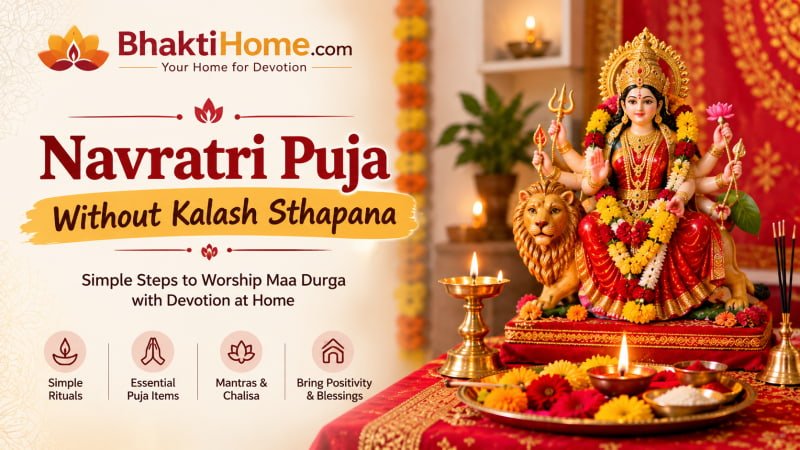
Navratri Puja Without Kalash Sthapana - Navratri is a sacred Hindu festival dedicated to Goddess Durga and her nine divine forms. Many devotees perform Navratri Puja at home to seek the Goddess's blessings for happiness, prosperity, good health, and protection. However, not everyone can arrange all the traditional puja items or perform Kalash Sthapana (Ghatasthapana) due to space constraints, time limitations, or personal circumstances.
Navratri Puja Without Kalash Sthapana: Is It Mandatory, and Can It Be Done?
The good news is that devotees can still worship Goddess Durga with devotion, prayers, and a sincere heart, even if they cannot perform the traditional Kalash Sthapana. You can offer flowers, light a diya, chant Durga mantras, recite the Durga Chalisa, or perform a simple daily puja according to your family traditions.
In this guide, we explain how to perform Navratri Puja without Kalash Sthapana, which rituals you can follow at home, and what to keep in mind while worshipping Maa Durga during these auspicious nine days.
Introduction
Navratri, the nine nights dedicated to Goddess Durga in her nine forms (Navadurga), begins with Kalash Sthapana, also called Ghatasthapana. Many devotees cannot do it for practical reasons, such as travel, a small or shared living space, hostel or rented accommodation, or a family situation. This leads to a common worry: is the puja incomplete or invalid without it?
Short answer: Kalash Sthapana is an important traditional ritual, but it is not a strict condition for worshipping the Goddess or for observing Navratri. Navratri puja can be done sincerely and correctly without it.
What Is Kalash Sthapana?
Kalash Sthapana is the ritual installation of a sacred pot on the first day (Pratipada) of Navratri. It typically involves:
- A clean earthen, copper, or brass pot filled with water (often with Ganga jal, if available)
- Mango leaves (or other auspicious leaves) around the rim, topped with a coconut wrapped in red cloth or a chunari
- Betel nut, a coin, rice grains, and sometimes durva grass inside the pot
- A bed of soil with barley (jau) sown beneath or beside it, whose growth over nine days is seen as a sign of prosperity
- Often an Akhand Jyoti, a lamp kept burning through the nine days
Symbolism: The Kalash is regarded as the seat or embodiment of the Goddess and, in many traditions, of all the deities, with the Trimurti (Brahma, Vishnu, Shiva) associated with its parts. It marks the formal invocation (avahan) of Shakti into the home for the nine days.
Its Importance
- Formal invocation: It marks the beginning of the nine-day worship.
- A focal point: It gives the household a sacred center for daily puja, aarti, and mantra chanting.
- Symbol of abundance: The sprouting barley is traditionally read as a sign of prosperity.
- Discipline: Keeping the Kalash encourages cleanliness, regularity, and a devotional atmosphere at home.
- Family tradition (kul parampara): In many families it is passed down for generations and carries emotional and cultural weight.
Is It Mandatory?
No, not in the sense that Navratri worship is invalid without it.
- Scholarly and priestly view: The detailed vidhi (procedure) in the Puranic and Devi-centered texts and in regional almanacs presents Ghatasthapana as the prescribed beginning for a full, formal Navratri anushthana. But the weight of the tradition falls on the Goddess's worship, sankalp (resolve), mantra, fasting, and devotion rather than on the pot alone.
- A guiding principle of Hindu worship is that devotion (bhava) is what gives a ritual its value. Mental worship (manasik puja) is traditionally regarded as fully valid when physical offerings are not possible.
- Practice varies by region and community. In Gujarat, the garbo (a lamp in a perforated pot) is the central symbol. In Bengal's Durga Puja, the ghat and idol are installed on different days and in a different sequence. Many households worship only a picture or idol of the Goddess without a Kalash, and this is widely accepted.
- It is a family-tradition matter. If your family has always done Kalash Sthapana, continuing is meaningful, and it's reasonable to ask an elder or your family priest before changing it.
When It Is Fine to Skip It
- You are traveling, in a hostel, or in temporary or rented accommodation
- You cannot keep the pot undisturbed and tended for nine days
- Space, health, or time constraints make daily upkeep difficult
- There is a death in the family (sutak), where customs often restrict formal rituals; many families then observe Navratri through mantra and mental worship only
- You are observing Navratri for the first time and want to begin simply
There is also a practical point. Once installed, the Kalash is expected to be tended daily with water, a lamp, and puja, and the home is traditionally not left unattended for long. An installed Kalash that is then neglected is generally considered worse than not installing one. A simple, regular, sincere puja is better than an elaborate one that can't be kept up.
How to Do Navratri Puja Without Kalash
1. Prepare the space. Clean the puja area and spread a clean red or yellow cloth.
2. Place the Goddess. Use a picture or idol of Maa Durga, or a Durga/Shri Yantra if you have one. Some people place a betel nut (supari) or a small lota of water as a simple symbolic seat.
3. Light a diya (and incense) before the Goddess. This can serve as the "constant" presence in place of the Kalash.
4. Take a sankalp. Quietly state your intention: that you are observing Navratri worship, with your name and your wish or prayer.
5. Daily puja. Offer flowers (red hibiscus is traditionally dear to the Goddess), roli/kumkum, rice, fruits, sweets, and a simple naivedya.
6. Chant. Options include:
- Sarva-mangala-mangalye shive sarvartha-sadhike, sharanye tryambake gauri narayani namostute
- The Navarna mantra: Om Aim Hreem Kleem Chamundaye Vichche
- Durga Chalisa, Durga Saptashati (or a portion of it), or Devi Kavach
7. Aarti, morning and/or evening.
8. Worship the Navadurga by dedicating each day to one form (Shailputri, Brahmacharini, Chandraghanta, Kushmanda, Skandamata, Katyayani, Kalaratri, Mahagauri, Siddhidatri).
9. Fasting (optional). Observe it according to your health and family custom.
10. Conclude with Kanya Pujan on Ashtami or Navami if you follow it, and offer your prayers of gratitude.
Common Questions
Will the puja give less benefit without a Kalash?
There is no scriptural basis for saying devotion without a Kalash is "less effective." Sincerity, regularity, and purity of intent are what tradition emphasizes.
Can I do Ghatasthapana later, on another day?
Timing rules are strict in tradition. The prescribed time is on Pratipada, and priests advise on the muhurat for the year. If you miss it, it's best to consult a priest rather than install it on an arbitrary day, or simply continue with picture-based puja.
Is a Kalash needed for the fast?
No. Fasting and puja are independent of the Kalash.
Conclusion
Kalash Sthapana is a beautiful and meaningful tradition, but it is not a condition for worshipping the Goddess during Navratri. If you can do it properly and consistently, it adds structure and sanctity. If you can't, a clean space, a picture or idol of Maa Durga, a lit diya, daily mantra and aarti, and a sincere heart are enough for a complete and valid Navratri observance. For specifics tied to your family's customs or your region, a trusted priest or elder is the best guide.
